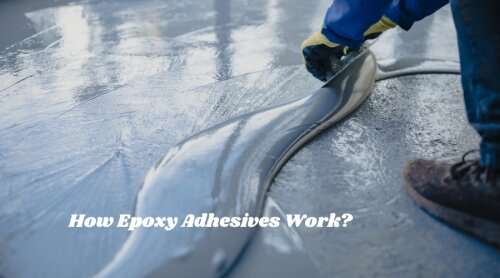
Epoxy glues form outstanding bonds among materials. These are multi-purpose glues in that they can be used on metal, plastic, wood, glass, and ceramics. Knowledge of epoxy's functionality helps the user apply it properly to achieve optimal strength. The science of epoxy bonding is interesting, though not complex to understand.
Basic Components
Epoxy adhesive consists of two components kept in separate containers. The resin is mixed with the hardener in a separate part. Neither one operates on its own. Combining them prompts a chemical reaction that forms the final adhesive.
The Two-Part System
To epoxy, this two-part design has particular benefits. Unmixed components have long-term stability. The user controls the hardening process by selecting when to mix. This flexibility would allow preparation without time pressure.
Common Forms
Epoxy is available in different types of liquids, pastes, and putties. Liquid epoxies can fill crevices. Paste forms remain in their original form. Before hardening, putty epoxies can then be molded. Both of them have dissimilar application requirements.
What Happens During Mixing
Molecules of each component combine when resin and hardener mix. This process is called cross-linking. The small molecules will be used to build large, complex structures. These build up the solid, robust cured epoxy.
Heat Generation
The heat is emitted during the cross-linking reaction. This is why mixed epoxy is warm to the touch during curing. The best is huge batches rather than small amounts. The heating is, in fact, a good indication that the chemical reaction is proceeding correctly.
Irreversible Change
Epoxy can never go back to liquid after being cured. The chemical bonds obtained are strong but permanent. In contrast, materials such as wax melt and solidify repeatedly. Cured epoxy is hard even at elevated temperatures.
Mechanical Bonding
Epoxy is released into small surface depressions and allowed to dry. These are microscopic pits and scratches present in every surface, including the smooth surfaces. As the epoxy is hardened in these spaces, it mechanically adheres to the surface in a manner similar to puzzle pieces, and thus it adheres to the surface.
Chemical Bonding
Epoxy molecules also form chemical bonds with surface molecules. Such bonds form at the molecular level when the epoxy directly binds to the material. The chemical bonding provision forms strong bonds that are difficult to break.
Surface Preparation
Widespread dirty smooth surfaces form weaker connections with dirty rough ones. There is no normal contact due to oil, dust, and contaminants. Lightly sanding helps to create more zones of mechanical bonding and surface area. Final strength is very much dependent on proper preparation.
Mixing Ratio
The resin-to-hardener ratio should be correct to ensure complete hardening. Excess resin results in a material that is not fully reacted and thus makes weaker bonds. Overly hardened, brittle connections are formed. The manufacturers set specific performance targets. Efficient measuring is a guarantee of a correct reaction to a chemical.
Initial Working Time
Epoxy has a fixed duration of working time or pot life. This can take time, from minutes to hours, with respect to formulation. Epoxies are fast-setting materials that can be hardened quickly, whereas slow ones can be left in position.
Gel Stage
Epoxy gels become sticky as the curing process continues. It can no longer run, but has not become full force. Disruptive epoxy at gel phase compromises final bonds. This stage should not involve any disturbance of parts.
Full Cure
Complete hardening is a time-consuming process compared to initial setting. Epoxy can harden within a few hours yet continue to increase in strength days later. The time of complete cure is between a night and a few days. The ultimate strength does not occur until complete curing.
Fast-Setting Epoxies
Quick-cure hardens in minutes. They are applicable for emergency repairs and when one needs strength quickly. The decrease in working time and, possibly, the ultimate strength are the trade-offs compared to the slower versions.
Standard Epoxies
Typical epoxies take hours or even days to cure. They strike a balance between working hours and a reasonably fast increase in strength. These are generalized formulations that perform well in everyday bonding.
Slow-Cure Epoxies
Epoxies with an extended cure require days to harden. They can be used to construct complicated assemblies that must be carefully positioned. Slow drying normally results in tougher end bonds. Big projects have the advantage of prolonged working hours.
Tensile Strength
Cured epoxy is subjected to a massive force when pulled. Good epoxies can withstand tensile forces up to several thousand pounds per square inch. This renders epoxy suitable for load-carrying.
Shear Strength
Epoxy also has tremendous resistance to sliding forces. As bonded surfaces move relative to each other, the epoxy sticks. The epoxy has high shear strength and is thus suitable for joints subject to sideways forces.
Impact Resistance
Regular epoxies are rather fragile under severe shocks. More complex formulations, however, contain additives that enhance the impact resistance. Such epoxies with modified properties can absorb shock while maintaining a high degree of bonding.
Heat Resistance
Cured epoxy retains strength over an extensive range of temperatures. Everyday recipes operate between -30 and 80 °C. There are specialized epoxy materials that can withstand temperatures above 150 degrees. This thermal stability applies to most industrial uses.
Cold Performance
The epoxy is suitable for freezing environments where other adhesives cannot withstand freezing. The treated substance is not brittle in the cold. This has rendered epoxy appropriate for outdoor and refrigeration applications.
Solvent Resistance
Epoxy establishes a manual for most solvents, such as gasoline, oil, and cleaning chemicals, which are fully cured. This epoxy-resistance contributes to its use in automotive, marine, and industrial applications. Bonds of proper cure are not weakened by chemical exposure.
Water Resistance
Epoxy has waterproof seals that neither soften nor dissolve in water. Applications Underwater applications and wet environments are no problem. This is waterproof, so the bonds do not weaken over time.
Proper Mixing
An extensive mix helps achieve a uniform reaction throughout the adhesive. Unmixed pockets. Curing may not take place due to incomplete mixing. Shake according to the duration indicated by the manufacturer. Wipe the sides and bottom of the scrape containers to ensure all material is added.
The thin layers are more reliable to cure than the thick layers. Large masses can produce excessive heat or cure unevenly. Several thin coatings are more efficient than one thick coating. Gap-filling programs should have thick-section formulations.
Epoxy adhesives are chemically cross-linked into a strong relationship between molecules. Epoxy adhesives are versatile and strong, which is the reason why they are essential in the industries of manufacturing, construction work, and repair.
Adhesives are everywhere. They join furniture, close gaps in bathrooms, bond construction materia
READ FULLA waterproof glue is also important for numerous projects at home and in workplaces. The common g
READ FULLIdentifying the appropriate polyurethane sealant distributor is crucial to the project's succes
READ FULL