Adhesives are everywhere. They join furniture, close gaps in bathrooms, bond construction materials, bond electronic components, and other building materials. However, not every adhesive is designed to perform the same. When water is involved, the type of adhesive applied is a major concern. Application of the incorrect one will result in bond failures, damaged surfaces, and high repair costs.
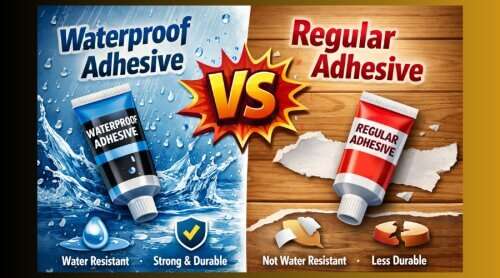
A regular adhesive is intended for routine bonding jobs in dry or low-moisture conditions. It welds excellently in usual conditions. However, it is not designed to withstand extended water exposure, wetness, or humidity.
The process of regular adhesives is simple in bonding. When used properly, they provide a good bond between two surfaces. The bond hold is well so long as things remain dry. Add water or regular moisture, and the bond loosens. Gradually, it disintegrates completely.
They include wood glues, basic craft glues, and general-purpose contact adhesives. These are optimal when there is an indoor project, dry land, and a controlled environment. They are incapable of outdoor use or use in wet environments.
A waterproof adhesive is developed to sustain its connection despite the influence of water, moisture, or wet climatic conditions. It is not disintegrated when moist. It is not susceptible to water intrusion along the bond line. The bond remains firm despite the surface that is either partially wet or permanently full.
Applications of waterproofing adhesives are designed for use in bathrooms, kitchens, outdoor furniture, and other areas where water cannot be ignored.
Depending on the use, they are produced using a variety of chemical bases. Some are silicone-based. Others employ polyurethane, epoxy, or modified polymer formulas. Each type possesses its own strong points and applications.
Water Resistance
This is the most evident difference. Standard adhesives can absorb moisture. The bond becomes tender, weak, and fails. Waterproof adhesives prevent this from occurring. They are chemically designed to exclude water rather than take it in. The bond is still maintained after successive wetting and drying.
Flexibility
Numerous waterproof adhesives are curable and have no hardness. This is of significance in settings where surfaces expand and contract as a result of alterations in temperature or moisture. Under these conditions, a rigid bond will crack and fail. A flexible waterproof bond moves along with the surface and remains intact.
Standard adhesives are usually harder once they have dried. These are fine in stable, dry climates. However, rigidity is a weakness in the outdoor or wet environment.
Curing Time
Waterproof adhesives usually require a long time to dry compared to normal glues. It may take hours for epoxy-based waterproof adhesives to cure fully. Regular adhesives tend to dry more quickly. There are craft glues and wood glues that work in minutes.
Temperature Resistance
Waterproof adhesives usually handle both extremes of temperature better than regular adhesives. Conditions of outdoors, direct sunlight, frost, and heat cycles are all conditions that test the long life of an adhesive. The waterproof formula is made resistant to such variations. Regular adhesive may be softened at high temperatures and become brittle at low temperatures.
Chemical Resistance
The majority of waterproof adhesives do not react to chemicals, cleaning agents, or solvents as well. In the kitchen, laboratories, and industrial settings, this is important because surfaces are often wiped with rough products. Normal adhesives dissolve when exposed to such materials.
Silicone
Waterproof is one of the most popular adhesives prepared using silicone. It is non-porous, heat-resistant, elastic, and adheres to non-porous surfaces such as glass, metal, and ceramic.
Silicone does not bond well with every material. It does not work on wood and selected plastics. Surface preparation is significant. Silicone needs to be applied appropriately on clean and dry surfaces.
Epoxy Adhesive
Epoxy is a two-part adhesive product that is sold together with a resin and a hardener. They form a very strong bond that is stiff when combined. Epoxy adhesives are very strong, waterproof and resistant to chemicals and is incredibly strong.
It is used in marine repair, metal bonding, concrete patching, and structural repair. In addition to metal, wood, concrete, and most plastics, epoxy bonds most materials. The primary disadvantage is that once cured, it is stiff. It does not flex. This renders it inappropriate in cases where movement is required.
Polyurethane
Polyurethane adhesives are robust and entirely waterproof. They bond to a wide variety of materials. They dry a little and thus seal cracks that provide depth and bind them together.
This is applied in construction, outdoor furniture, and flooring. The polyurethane adhesives are waterproof. This makes them an acceptable alternative for outdoor projects.
Modified Polymer Adhesives
They are more recent formulations that integrate the flexibility of silicone with the bonding properties of polyurethane. They bond well to practically all surfaces, become flexible once cured, and are completely waterproof. They can be painted, and silicone does not. They are finding an additional application in building and DIY projects where multiple uses are valued.
Apply regular adhesive to interior projects not related to moisture. Wood joinery is intended as a standard, as are paper crafts and even dry surface bonding.
Use waterproof adhesive when the moisture is a factor. Under such conditions, do not expect a regular adhesive to work at least temporarily.
Both surface preparations are important.
No glue can work well on a poorly prepared surface. Regular adhesive and waterproof adhesive need clean and dry surfaces, as well as being grease-free, to bond effectively.
Removing old adhesive, dust, and grease, and applying anything new. Use the manufacturer's application and curing time instructions. A quick process yields poor bonds despite high adhesive quality.
It is not the water resistance that differentiates between waterproof and regular adhesive. It reduces to the resistance, versatility, and environmental suitability of the bond to which it will be subjected. Choosing the right type of adhesive will save time, money, and the hassle of constant repairs.
Adhesives are everywhere. They join furniture, close gaps in bathrooms, bond construction materia
READ FULLA waterproof glue is also important for numerous projects at home and in workplaces. The common g
READ FULLIdentifying the appropriate polyurethane sealant distributor is crucial to the project's succes
READ FULL